
01Clinical Context and Referral
The patient developed progressive respiratory failure after arriving in France and was admitted to Hôpital Européen Georges-Pompidou. Investigations confirmed Pneumocystis jirovecii pneumonia, followed by severe acute respiratory distress syndrome. Despite advanced intensive-care treatment and invasive mechanical ventilation, extracorporeal support became necessary and VV-ECMO was initiated.
Specialists in France and Brazil coordinated the next phase of treatment, and the patient was accepted for ongoing ECMO care at Hospital das Clínicas, University of São Paulo. Brasil Vida Air Ambulance was then asked to assess and organise the intercontinental transport.
02Planning the International Mission
The mission required detailed preparation across clinical, aviation and logistical workstreams. The medical transport team was assembled in less than 24 hours, while operational planning continued over the following 48 hours.
The mission brought together clinical and operational teams in France and Brazil, each with a defined role within a single coordinated transport plan. The referring ICU prepared the patient for transfer, the receiving centre reviewed the clinical status and confirmed continuity of ECMO care, and Brasil Vida coordinated the aircraft, flight permissions, handling, ground transport, equipment, oxygen planning and international communications.
The transport plan covered every stage from ICU departure in Paris to final bedside handover in São Paulo.
03Building a Mobile Intensive Care Unit
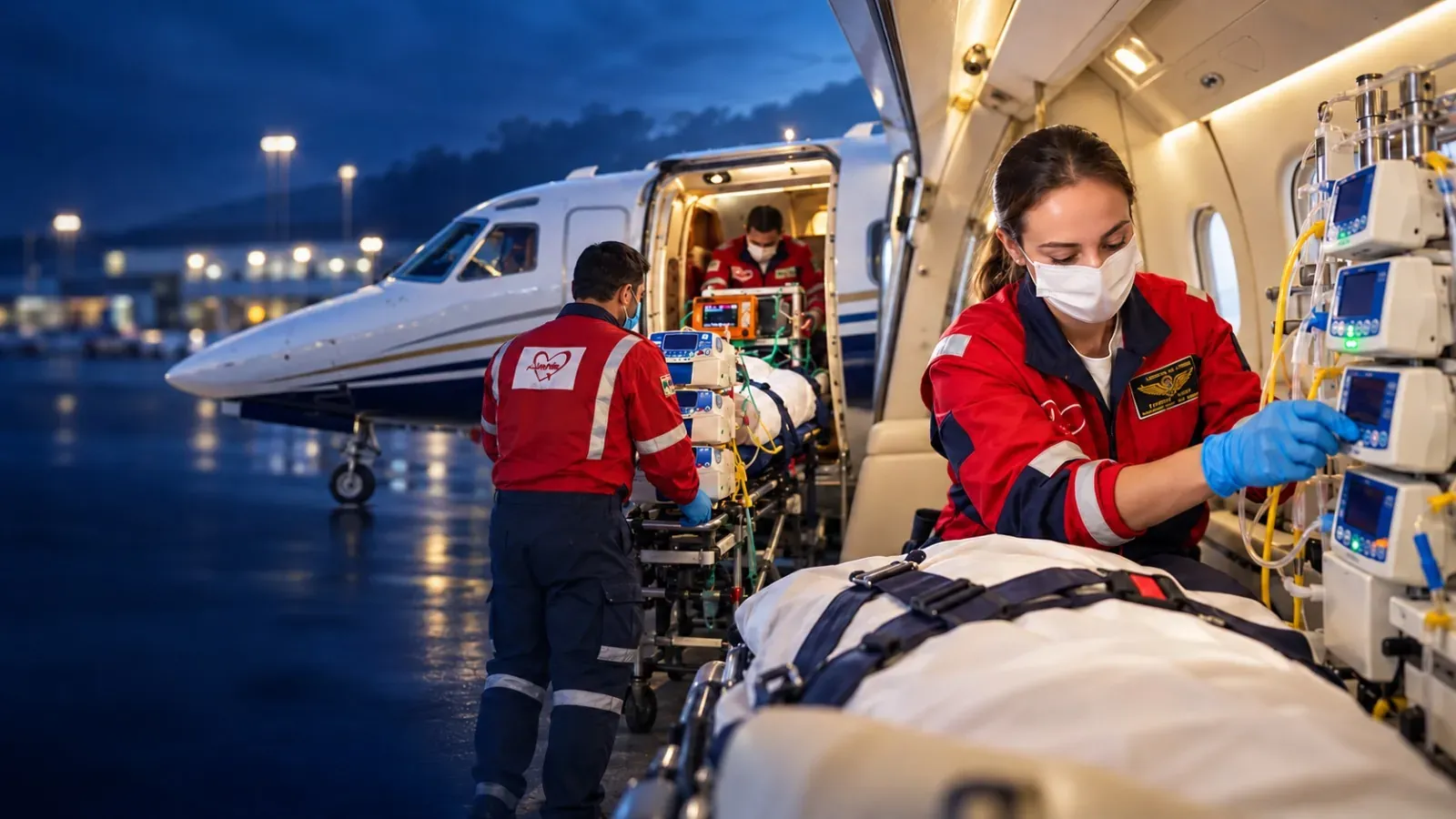
The transport was performed using a Gulfstream G100 configured for long-range aeromedical operations. For an ECMO patient, the cabin must function as a compact intensive-care environment in which equipment stability, patient access and redundancy are carefully balanced.
The aircraft was configured to accommodate the ECMO console and circuit, heater unit, transport ventilator, multiparameter monitoring, infusion pumps and emergency equipment while maintaining safe access to the patient throughout the flight.
Three large oxygen cylinders and two portable cylinders were loaded before departure. Oxygen calculations were deliberately conservative, and the contingency plan included the possibility of replenishment during technical stops if required.
The principle was straightforward: once airborne, every essential capability had to be available inside the aircraft.
04A Multidisciplinary Critical-Care Team
The aeromedical team reflected the clinical complexity of the mission. Brasil Vida provided two experienced Gulfstream captains, a senior flight nurse and the transport intensivist. The team was joined by two ECMO physicians from Hospital das Clínicas and an ECMO perfusion nurse.
Before departure, the transport team and the French ICU conducted a comprehensive clinical review covering ventilator settings, ECMO parameters, anticoagulation, infusion therapy, vascular access, laboratory findings, imaging and contingency planning.
Direct communication with the French clinical team, ground ambulance provider and airport personnel supported efficient decision-making during the transfer from hospital to aircraft.
05Hospital to Aircraft
Following final clinical checks at Hôpital Européen Georges-Pompidou, the patient was transferred by ground ambulance to Paris-Le Bourget Airport.
Shortly before departure, the team identified an incompatibility between oxygen connectors used by the local ambulance service and the equipment available for the aircraft transfer. The issue was resolved through local coordination without affecting the overall mission timeline.
This practical detail highlighted the importance of checking interfaces between hospital, ground and aircraft systems before each stage of a complex international transport.
06Crossing the Atlantic on VV-ECMO
At departure, the patient remained critically ill but stable for long-range transport. He was deeply sedated and pharmacologically paralysed, with ongoing anticoagulation, vasoactive support, lung-protective mechanical ventilation and continuous VV-ECMO.
The planned route included technical stops in Sal Island, Cabo Verde and Salvador, Brazil before continuing to São Paulo. Throughout the crossing, monitoring included invasive blood pressure, electrocardiography, pulse oximetry, urine output, ventilatory parameters and continuous ECMO surveillance. Serial arterial and venous blood-gas analyses guided adjustments in ventilation, sweep gas flow and metabolic management.
The cabin configuration allowed the team to access the patient, ECMO circuit, ventilator, infusion pumps and monitoring systems throughout the mission. Clinical tasks were coordinated around the limited space available, with team members changing positions according to the procedure being performed.
07Oxygen Management and Redundancy
Oxygen use was continuously reassessed during the flight. Serial blood-gas analyses showed stable gas exchange, allowing gradual optimisation of sweep gas flow and oxygen consumption. Actual use was lower than the conservative planning scenario, and approximately half of the onboard oxygen reserve remained available at the end of the mission.
The result reflected both advance planning and continuous clinical reassessment during the crossing.
08Managing Operational Variables in Flight
The combined weight of the patient, specialist equipment and transport team increased the aircraft load, while stronger-than-forecast headwinds reduced ground speed over parts of the Atlantic.
The flight crew continuously recalculated fuel margins, altitude and flight profile. An additional technical stop in Tenerife was considered as a contingency if fuel consumption exceeded the planned limits. The captains adjusted speed and altitude to optimise aircraft performance while preserving appropriate operational margins, and the additional stop was ultimately not required.
For a long-range critical-care mission, aviation decisions and medical priorities cannot be managed independently. Flight profile, fuel planning, oxygen strategy and total transport time must be considered together.
09Maintaining Stability Across the Atlantic
The patient remained physiologically stable throughout the journey. Mechanical ventilation continued under the established lung-protective strategy, ECMO maintained effective blood flow and gas exchange, and haemodynamic stability was maintained with low-dose vasoactive support.
Routine checks showed stable ECMO circuit performance without visible thrombus formation or cannulation-related complications. The transport ventilator, infusion pumps and monitoring systems operated as expected throughout the flight.
The absence of a major clinical event was one of the most important outcomes of the mission. Maintaining advanced organ support across approximately 9,500 km depended on disciplined monitoring, careful preparation and continuous coordination.
10Arrival and Continuity of Care
The aircraft landed in São Paulo after approximately 9,500 km of continuous critical-care transport. An advanced life support ambulance was positioned on arrival, and the transfer from aircraft to ground ambulance was completed with uninterrupted monitoring, mechanical ventilation, intravenous therapy and VV-ECMO support.
The patient was transported directly to the Intensive Care Unit at Hospital das Clínicas, University of São Paulo.
A comprehensive bedside handover covered the clinical course in France, ventilatory strategy, ECMO settings, anticoagulation, vasoactive support, laboratory trends, medications administered during transport, oxygen consumption and all relevant interventions performed during the mission.
The transport was complete only after clinical responsibility had been formally transferred to the receiving intensivists.